
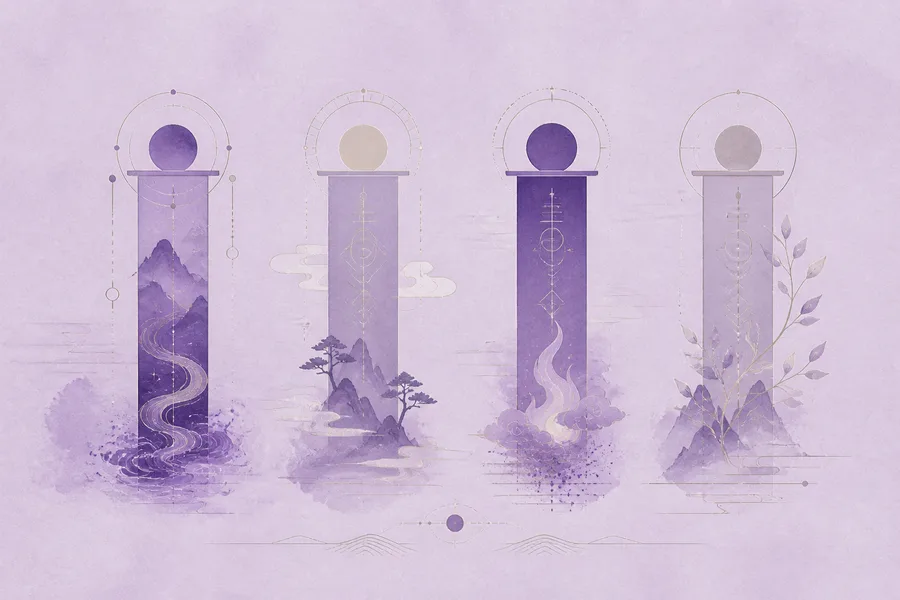
BaZi (八字), often translated as the Eight Characters, records four pairs of Chinese calendrical signs. The year, month, day, and hour each become a pillar made from one Heavenly Stem and one Earthly Branch.
Why there are eight characters
Four pillars multiplied by two signs gives the chart its familiar name. The signs also carry yin–yang and Five-Element associations, creating a compact model of relationships rather than a list of isolated labels.
The Day Master
The stem of the day pillar is commonly called the Day Master. It provides a reference point for describing how the other stems and branches relate to the person represented by the chart. It is a starting coordinate, not a personality score.
Calculation assumptions matter
Calendar boundaries, time zone, daylight-saving rules, and the treatment of local solar time can change a pillar near a boundary. A trustworthy chart experience should keep the entered civil time and calculation method visible instead of hiding them behind the result.
Purple Heaven treats the chart as derived data: the profile and its calculation settings remain authoritative, while the chart can be recalculated as methods improve.